


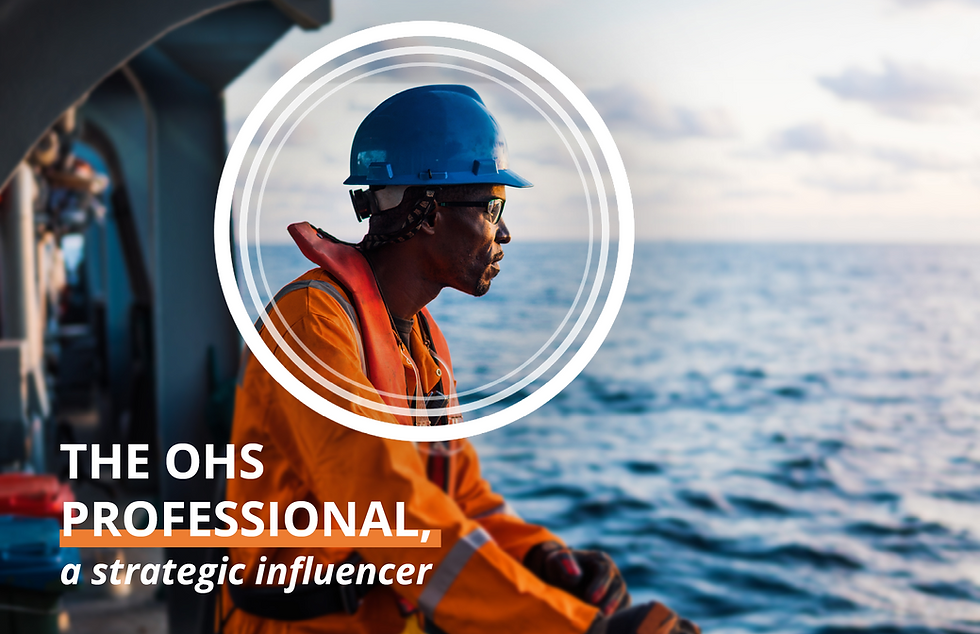
THE OHS PROFESSIONAL a strategic influencer
Updated: May 14
Understanding organizational culture as the foundation of OHS success
According to Gérald Perrier, the president of Perrier Consulting, an understanding of the overall culture specific to an organization is closely related to the success of its health and safety interventions. The term “overall culture” refers to an organization’s values, beliefs and ways of doing things.
This article will demonstrate the direct connection that exists between desired health and safety outcomes and the cultural dimension of an organization from the viewpoint of the OHS professional who has to adapt their behaviour and adjust their interventions in order to become a strategic influencer.
With more than 50 years of experience in the field of workplace risk prevention, Gérald Perrier has had the opportunity to collaborate with many organizations and, in doing so, has been exposed to many different corporate cultures. The experience gained over the years has taught him that, regardless of whether the OHS professional is from within the organization or not, excellent familiarity with the organization where they are called upon to intervene is essential. It is important to have a good understanding of an organization’s specific challenges to become a positive influencer among operations managers at every level. OHS professionals have to have a good grasp of all the business components that exist within their organization.
The core dilemma: technical expertise vs organizational understanding
Regardless of the country or culture, we’ve noticed that when an organization has trouble managing risks, this same shortcoming can also be seen in other areas such as quality, efficiency, performance and teamwork. The area of health and safety is no exception; it is as important as these other issues in a company’s overall success.
The dilemma that comes up most frequently is that, although OHS professionals are experts in health and safety matters, such as critical risk control, root cause analysis, etc., they are not necessarily skilled at incorporating health and safety into all the components of a company because they do not have an overall understanding of these components. The future of the involvement of OHS professionals requires that
they become positive influencers among operational decision makers, managers and leaders. It is crucial that they be connected to matters that extend beyond their technical health and safety knowledge.
Understanding the business model: a key lever of influence
OHS professionals need to study the organization’s business model in order to grasp the very essence of the corporate objectives. This closeness allows them incorporate into their interventions all factors related to the culture of the organization, giving them an opportunity to become strong, respected influencers. A company’s existence is driven by profitability and profit making. To achieve these, it has to develop
efficient production processes or provide quality services. It is understandable, then, that health and safety matters are not naturally a top concern. Regardless of its business activity, an organization isn’t born to handle risk management on a daily basis; its raison d’être is to achieve specific business goals. The role of an OHS professional is to work with these goals and, the closer they get to them, the more aware decision makers are of their positive impact. This is exactly what Gérald Perrier noticed on the ground over the years by using this approach. He managed to identify a direct positive correlation between OHS professionals’ ability to understand the organization and the impact of their interventions.
From expertise to impact: becoming a key organizational player
Getting close to businesspeople, understanding how their business operates and finding in the business, through its specific culture, personalized ways of incorporating prevention – this is the role of the OHS professional. The future of OHS professionals lies in their success in becoming strong influencers, and to manage this, they have to open these doors of communication and penetrate the company, becoming key
players, not just health and safety experts.
“ … to drive safety forward in a sustainable manner we can no longer treat it
as an independent variable. The reasons for safety success or failure
are always related to the health of the organization as a whole.”
-Peter T. Susca
Connecting culture, leadership and safety performance
This statement aligns perfectly with Gérald Perrier’s affirmation: in order to become influencers, OHS professionals have to know how to identify all the details of an organization and connect with its teams. They also have to seize the opportunity to develop proactive hazard and risk management indicators –even cultural indicators that are incident-reactive.
Our interventions, in collaboration with the OHS teams of our client organizations, emphasize the importance of monitoring the organization’s cultural indicators and identifying what OHS professionals have to learn to measure in the future. One example is measuring how supervisors impact workers by encouraging them to use best safety practices. There’s a big difference between measuring the implementation of safety measures and the quality of the message transmitted. In general, industries
follow OHS training plans and oversee their implementation.
But they do not dwell on the methods or the quality of the communications between managers and workers, which makes one question the true positive impact on workers’ appropriation of OHS measures. This is the big challenge faced by OHS professionals: to successfully understand these relationships, the hierarchies inherent in every company, and to create prevention tools accordingly.
The strategic goal: becoming true influencers
To achieve their ultimate goal, that of becoming strategic influencers, they will have to promote OHS and risk management at every level of the company, by becoming indicators of its strength and by having a comprehensive view of the issues.
To play a role within an organization, an OHS professional has to establish a strategic development plan based on their knowledge of the company. This allows them to identify how to influence the people in operations, how to be impactful through their intervention and how to become strong influencers. Using this strategy, they will be able to create the desired connection with workers and even change workers’ perceptions and opinions of health and safety in a positive way. This is how OHS professionals can increase their value beyond their technical skills and become valuable allies of production managers. Once this partnership process has begun, the OHS professional’s positive impact will allow her or him to develop strategic levers and create new impacts.
Lever 1: alignment with internal clients and reality on the ground
From the outset, the first strategic lever that OHS professionals need to take into consideration is calibrating with internal clients, managers, supervisors, and operators and understanding their vision of how to manage and operate the organization that they work in. This upgrading of the professional’s knowledge by understanding existing behaviours will provide a starting point for deciding what actions to take. For the OHS professional, the internal consulting approach is the best way to deal with problems and examine the causes of actions. This examination of why activities are performed
in a certain way should automatically be part of a good OHS professional’s analysis. By using this approach, the OHS professional can avoid criticism without understanding why leaders within the organization make certain decisions and can help create a positive, constructive intervention environment based on an understanding of the reality of the company.
Lever 2: deep understanding of the business model
The second strategic lever focuses on upgrading OHS professionals’ knowledge of the organization. The more familiar they are with the organization’s business model, the more appropriate and successful their interventions will be on the floor. More often than not, we notice that OHS professionals don’t have sufficiently extensive knowledge of the business where they are trying toimplement new health and safety measures. Experience clearly shows that, in the majority of incidents, and even incidents with serious injuries, the direct causes are not training-related gaps or workers’ lack of knowledge about risks. Instead, most of the time, incident analysis reveals that the
root causes stem from the organization – how it operates and how it manages risk – or from the fact that risk management is not sufficiently incorporated into production priorities. The role of the OHS professional is to experience production realities and to ensure that health and safety prevention measures play a central role. However, a lot of work still needs to be done to achieve this goal.
Lever 3: continuous self-assessment and peer feedback
The third strategic lever involves OHS professionals regularly assessing their performance, questioning themselves and being evaluated by peers and internal clients. This exercise will allow them to make adjustments, understand themselves and be clear with themselves about the true impact that they have, or do not have at the time, through their interventions. In the desire to be good strategic partners, it is essential that they evaluate how others perceive them and what critical aspects they need to improve to reach their goal of becoming better influencers.
Lever 4: building credibility through presence and action
The fourth strategic lever is building and maintaining strong credibility among key people within the organization. Generally speaking, good leadership involves being credible, being present and being visible in on-the-ground activities and assuming responsibilities. This is precisely the path that OHS professionals need to take.
To build this credibility, Perrier Consulting recommends getting close to the base and earning the trust of managers and supervisors at all levels. Unfortunately, in recent years, we have noticed a tendency for OHS professionals to focus on developing and implementing systems rather than playing an active role. This dissociation distances the OHS professional from day-to-day prevention activities and has harmful negative effects on the implementation of health and safety measures. People in operations expect safety professionals to recommend practices, techniques and concrete applications. For OHS professionals, the best way to accomplish this is to team up with the operations crew and establish shared objectives. OHS professionals will gain credibility by fulfilling their role of finding sustainable, practical solutions for the operations staff.
Conclusion: the future of OHS as strategic global influence
In addition to the credibility lever, it is important to identify allies and work with them. When OHS professionals isolate themselves too much and play the role of super experts instead of acting as coaches and agents of positive change, they reduce the balance they are seeking to achieve through their intervention. It’s important to balance three components: expertise, the health and safety content and the coaching role, the latter being achieved through communication, listening and interpersonal skills, as well as dialogue. By properly understanding needs and realities, the OHS professional will easily be able to adjust their coaching approach to facilitate learning, the coaching
role always being related to learning and to how prevention measures are implemented through a vision that enables learning.
To summarize, OHS professionals need to be flexible in their vision and refresh their approach by constantly challenging themselves. We have noticed that, over the past 15 years, changes related to risk prevention and management in companies have occurred more quickly than in the 20 previous years. The continued relevance of OHS professionals is closely related to their ability to follow these changes and to exert their influence on decision makers through a deep understanding of this reality that involves fast decision-making and an ability to reorganize. By using all the strategic levers presented in this article, OHS professionals will earn the respect and acceptance of organizations and their role and interventions will be more impactful.

Comments